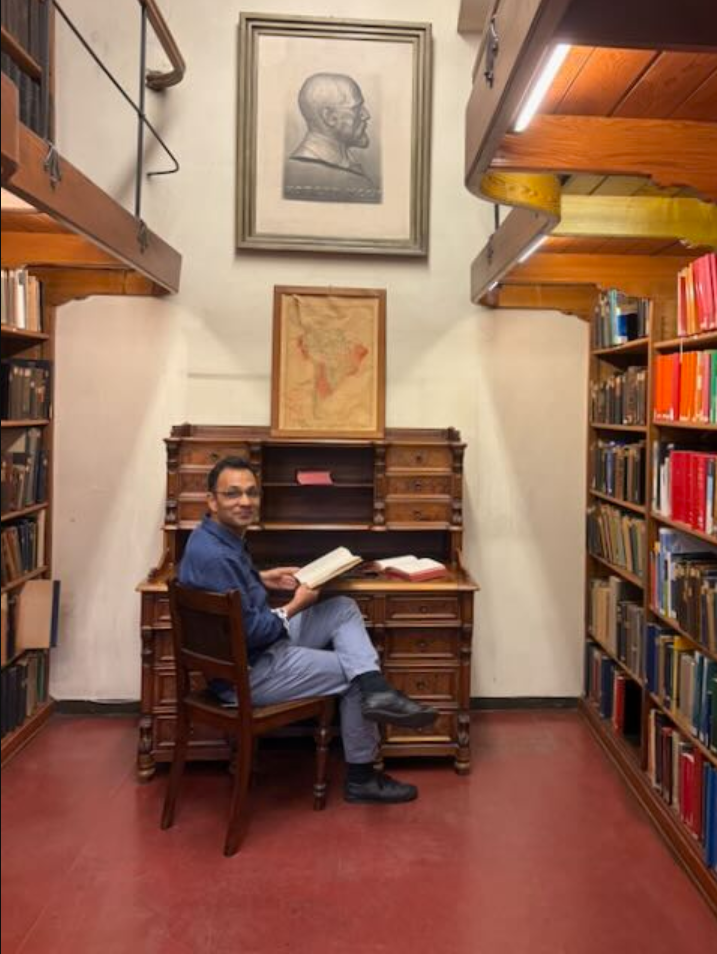
De La Salle University’s Dr. Anish M.S. Shrestha, Founding Head of AdRIC’s Bioinformatics Laboratory and Associate Professor at the College of Computer Studies, recently completed a visiting researcher stint at the Robert Koch Institute (RKI) in Berlin, Germany through the RIO Program.
The visit provided an opportunity for Dr. Shrestha to share DLSU’s research, learn from researchers at RKI, and explore possible areas for future collaboration. His discussions focused on wastewater-based surveillance, antimicrobial resistance, and the use of genomic and bioinformatics methods in public health research.
Dr. Shrestha’s work at DLSU includes the piloting of the first metagenomics-based profiling of antimicrobial resistance in hospital wastewater in Metro Manila. Building on this work, one of the main goals of his visit was to learn from RKI’s experience in wastewater-based epidemiological surveillance and explore approaches that could be practical and sustainable in the Philippine setting.
During his stay, Dr. Shrestha presented his research during an MF1-BTR group meeting and had discussions with researchers about their ongoing work. These conversations allowed him to share experiences from the Philippines while gaining a better understanding of the research being conducted at RKI.
He also met with members of AMELAG, who shared their experience in implementing routine wastewater-based epidemiological surveillance in Germany. They discussed the practical aspects of running such a program, including lessons learned from their experience, and explored how similar approaches might be developed in the Philippines.
Another part of the visit was a tour of the MF1-SeqLab, where Dr. Shrestha was able to see RKI’s sequencing facilities and laboratory processes firsthand. He also met with members of the ZIG4 team to discuss the challenges involved in developing sequencing capacity at DLSU and possible areas for future collaboration.
The research exchange also opened discussions on longer-term collaboration between DLSU and RKI. Both institutions are exploring the possibility of establishing a Memorandum of Understanding (MoU) that could support joint research proposals, researcher exchanges, and other academic activities. They are also looking into opportunities for joint publications, including work on pangenome graph-based approaches for genomic surveillance.
For Dr. Shrestha, the visit was an opportunity not only to learn from RKI’s experience but also to share the work being done at DLSU. The exchange allowed both sides to discuss common research interests, share experiences, and identify areas where their expertise could complement one another.
Dr. Shrestha expressed his sincere thanks to his host, Hugues Richard, and the entire BTR team for their warm welcome and generosity throughout his stay. He also thanked Aurélie for coordinating the arrangements and colleagues from AMELAG, SeqLab, and ZIG4 for taking the time to share their knowledge and experiences.
The RIO visit provided Dr. Shrestha with new perspectives and connections that can contribute to DLSU’s ongoing work in wastewater surveillance and bioinformatics. It also opened possibilities for continued collaboration between researchers in the Philippines and Germany, with the shared goal of advancing research that can contribute to public health.
Through research exchanges such as this, DLSU researchers gain opportunities to learn from institutions abroad while sharing the university’s own research and expertise. These connections can help create new research opportunities and bring valuable knowledge back to the university and the Philippines.