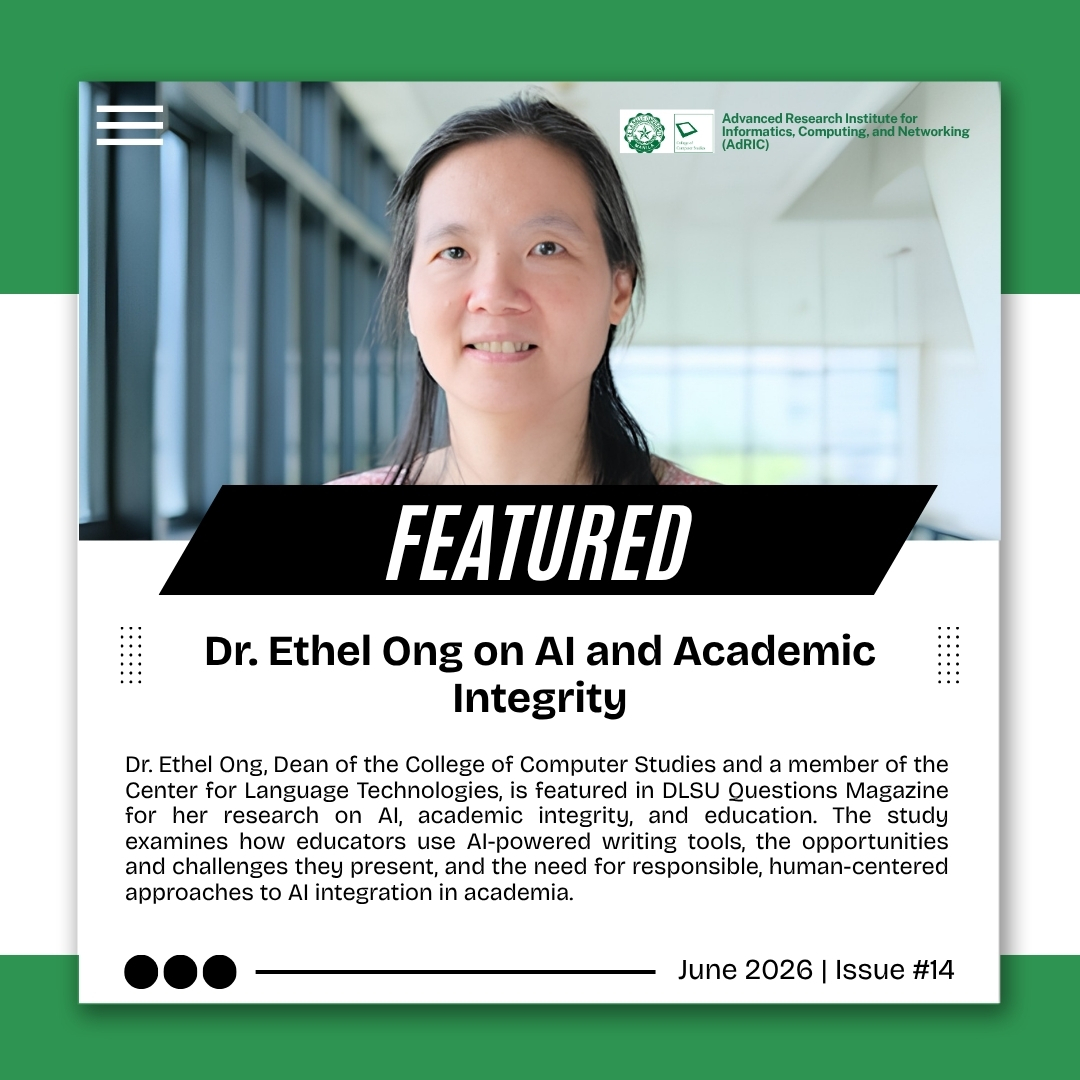
Dr. Ethel Ong, Dean of the College of Computer Studies (CCS) and a member of the Center for Language Technologies (CeLT) at De La Salle University, was recently featured in DLSU Questions Magazine for her contribution to a study examining academic integrity and the use of artificial intelligence in education.
The study, titled “Algorithmically Driven Writing and Academic Integrity: Exploring Educators’ Practices, Perceptions, and Policies in AI,” was conducted by a team of DLSU faculty researchers led by Dr. Leah Gustilo and Dr. Minie Rose Lapinid of the Br. Andrew Gonzalez FSC College of Education, with Dr. Ethel representing the College of Computer Studies.
Examining AI Use in Education
The rapid development and widespread adoption of artificial intelligence tools have transformed how students and educators access, process, and produce information. Since the emergence of ChatGPT and other Large Language Models (LLMs), educators have increasingly explored the opportunities these technologies provide while also raising concerns about their implications for academic integrity.
The research focuses on Algorithmically Driven Writing Tools (ADWTs), including Large Language Models such as ChatGPT, digital writing assistants such as Grammarly, machine translation tools such as Google Translate, and automated paraphrasing tools such as QuillBot.
Through a cross-sectional survey involving 100 educators and graduate students across 10 disciplines, the researchers examined how members of the academic community perceive and use these technologies, as well as the challenges institutions face in establishing responsible practices and policies surrounding AI.
To better understand technology adoption, the researchers applied the Technology Acceptance Model (TAM). The framework considers factors such as perceived usefulness and perceived ease of use, including the quality and relevance of the technology’s output, users’ confidence in working with technology, and the availability of technical support.
Balancing Opportunities and Academic Integrity
The study revealed that educators recognize the potential of AI-powered writing tools to support teaching, improve writing, and make academic tasks more efficient. At the same time, their adoption is accompanied by significant concerns.
Among the challenges identified were limited access to appropriate tools, insufficient knowledge and training, questions regarding the reliability of AI-generated outputs, and concerns surrounding academic integrity, creativity, and authorship. The researchers also noted that many educational institutions continue to lack clear and explicit policies governing the use of AI.
These findings highlight the need for universities to move beyond simply deciding whether AI should or should not be used. Instead, institutions need evidence-based policies, appropriate training, and teaching strategies that help educators and students understand how these technologies can be used responsibly.
Toward Human-Centered AI Integration
The research emphasizes the importance of a human-centered approach to AI integration in education. Rather than allowing technology to replace critical academic processes, AI tools should be incorporated in ways that support learning while maintaining ethical standards and the principles of academic integrity.
The study provides empirical insights that can help educational institutions develop policies, training programs, and pedagogical approaches for navigating the evolving role of AI in academia. It also underscores the importance of collaboration among educators, researchers, institutions, and technology developers in shaping how AI will influence the future of education.
Dr. Ethel’s involvement in the study reflects the College of Computer Studies’ continued contribution to interdisciplinary research at the intersection of technology and education. Her work highlights the importance of combining technological expertise with educational perspectives in addressing emerging challenges brought about by AI.
As artificial intelligence continues to reshape the academic landscape, research such as this provides an important foundation for ensuring that technological innovation remains aligned with responsible learning, ethical practice, and the development of a more empowered academic community.
Congratulations to Dr. Ethel Ong on this well-deserved feature in DLSU Questions Magazine! AdRIC is proud to recognize her contribution to research that helps advance informed and responsible conversations on AI and academic integrity in education.
This article is based on the feature published in DLSU Questions Magazine.